Amphibians in English for Kids
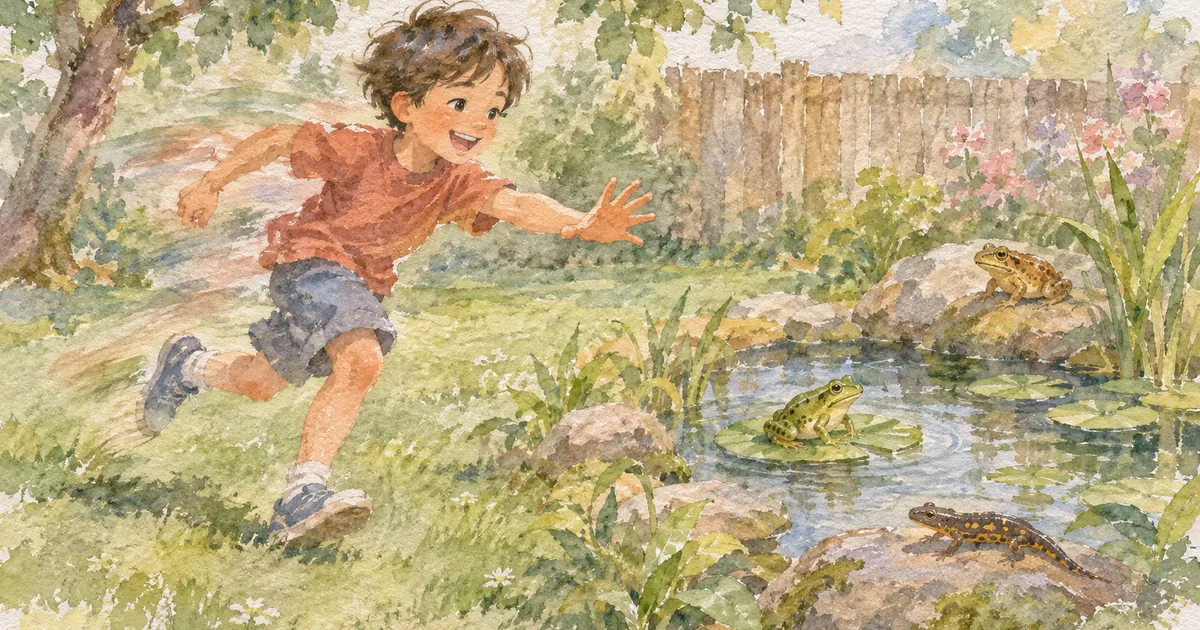
Amphibians are moisture-dependent vertebrates whose body temperature follows their surroundings. Frogs, toads, salamanders, newts, and caecilians belong to this group. Most begin life in water and change shape while growing—a vivid process children can describe in English. Amphibians in English for Kids: Words and Activities combines animal names, habitats, sentence patterns, and age-based games, linking science with language from the first lesson.
Essential Amphibian Words
Start with visible or actionable words. Frog, toad, pond, jump, and swim suit beginners. Older children can add caecilian, gills, wetland, and metamorphosis.
For a first lesson, Amphibians in English for Kids: Words and Activities should pair each word with its meaning and a spoken example. Pronounce difficult words in parts: am-FIB-ee-an and met-a-MOR-pho-sis.
Delay perfect spelling. Let beginners point, match, and speak before writing, keeping attention on meaning and sound.
Key Differences to Teach
Animal names rarely fit neat scientific boxes. A newt is a salamander; a toad is a frog. Teach these links as a family tree, not separate labels.
Amphibians in English for Kids: Words and Activities works best when children compare confusing terms. The descriptions below offer teaching clues, not exception-free rules.
Ask your child to explain one difference in a sentence. “A newt is a type of salamander” demonstrates understanding beyond naming either animal.
Put the Words into Sentences
Begin with four reusable frames: “This is a ___,” “It has ___,” “It lives in ___,” and “It can ___.” For example: “This is a frog. It has strong legs. It lives near a pond. It can jump.”
Practise singular and plural forms together: “one frog, two frogs.” Contrast “A frog jumps” with “Frogs jump.” Repeat with toads, newts, ponds, and eggs.
A frog life cycle creates a natural sequence for older beginners: “The eggs hatch. A tadpole comes out. It grows legs. It becomes a froglet. Its tail gets shorter. The adult frog can live on land and in water.” Present this as a common frog pattern, not every amphibian’s life story.
Introduce the Vocabulary Step by Step
A short routine makes Amphibians in English for Kids: Words and Activities memorable. On the first day, teach three animal names and two actions. Show a picture, name it, then ask your child to point, act, or choose between two pictures.
On the next day, add habitat and body terms. Sort pond, wetland, forest floor, gills, skin, legs, and tail under “place” or “body.” Accept a quick home-language explanation when needed, then repeat the English word.
On the third day, build a description or life-cycle sequence. Across LearnLink lessons, our tutors use questions and visual prompts to develop connected speech. At home, start with “What is it?” and continue with “Where does it live?”
Activities for Different Ages
Match each task to language level and age. A nine-year-old new to online English may need short directions and picture support like a younger learner.
- School-age kids: Place animal pictures on the floor. Call “frog,” “toad,” or “newt,” and let your child jump to the right picture.
- School-age kids: Sort cards into animal, body, action, and habitat groups. Use each card in a spoken sentence.
- Ages 10–12: Put frog life-cycle pictures in order, then describe each stage with one sentence.
- School-age kids: Make a short field-guide entry with classification, habitat, body features, and one careful comparison.
In mixed-age families, younger children can name and move while older children explain. The subject stays constant; language demands change.
Pond Detective
Choose one amphibian and give three clues without naming it: “It has a tail. It has four legs. It can live near water.” The listener asks, “Is it a salamander?” Swap roles and add a harder clue.
Review familiar words through matching, guessing, drawing, and describing. Varied tasks make one small word set work harder.
Common Language and Science Mistakes
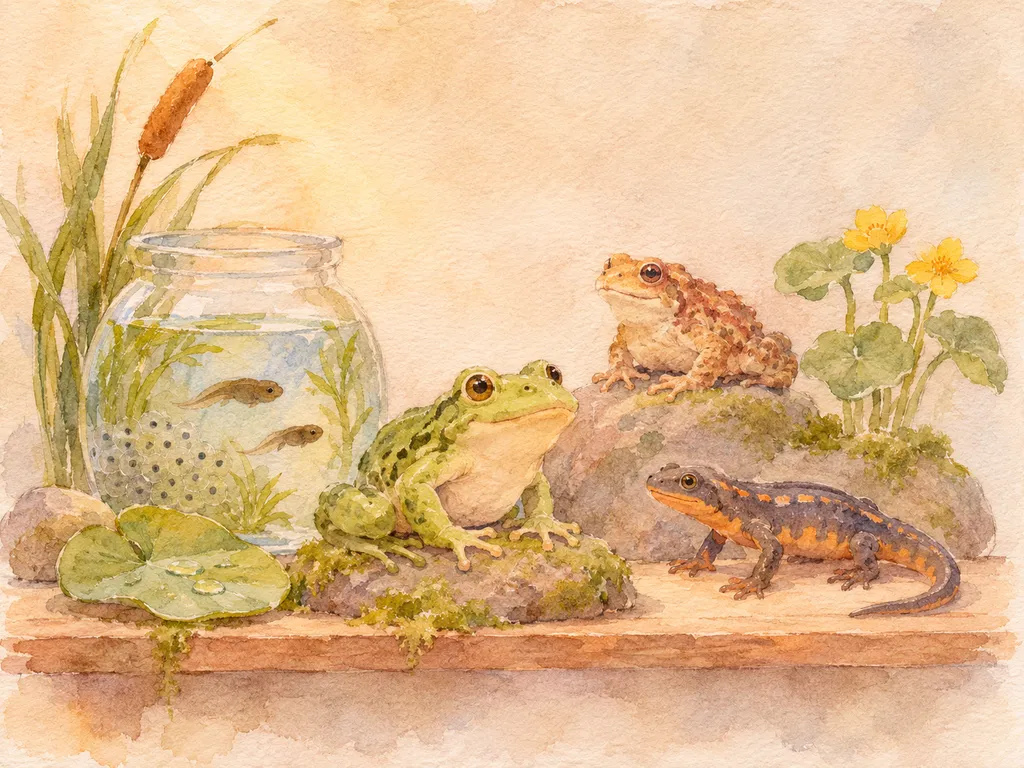
Children may say “It is frog” because some languages omit articles. Model “It is a frog” and “They are frogs.” Practise verb agreement: “A toad crawls,” but “Two toads crawl.”
Amphibian does not mean frog. Every frog is an amphibian, but salamanders and caecilians are amphibians too. A tadpole is a life stage, not another animal type.
Avoid claiming every amphibian spends exactly half its life in water and half on land. Life cycles and habitats vary. Prefer: “Amphibians need moisture, and many begin life in water.” This accurate pattern avoids a false rule.
- Sort six animal cards into amphibians and non-amphibians, then explain each choice.
- Contrast one amphibian with two amphibians to practise the correct plural.
- Check three unfamiliar amphibian words together in a reliable illustrated reference book.
- Compare a frog and a salamander using two accurate science sentences.
- Correct one mistaken label aloud, then ask your child to explain why.
When a word has several meanings or pronunciations, Cambridge Dictionary is a useful check before turning it into child-friendly examples.
Frequently Asked Questions
How Many Amphibian Words Should a Beginner Learn First?
Amphibians in English for Kids: Words and Activities can begin with six words: frog, toad, tadpole, pond, jump, and swim. Add newt, salamander, eggs, hatch, and gills after your child uses the first set confidently. A small active set beats a long repetition list.
What Is the Simplest Way to Explain an Amphibian?
An amphibian is a vertebrate that needs moisture and often begins life in water. Frogs, toads, salamanders, newts, and caecilians are amphibians. Pair the definition with two contrasting pictures, such as a frog and a lizard, instead of extra scientific terms.
Does My Child Need to Learn Difficult Words Such as Caecilian?
No. Young beginners can start with frog, toad, and tadpole. Introduce caecilian when your child is ready to explore more than one familiar body shape. Use an image and a short definition: “A caecilian is a legless amphibian.” Recognition can precede spelling.
How Can We Practise Amphibian Vocabulary Without Worksheets?
Use toy animals, drawings, picture cards, or safe pond observations. Ask your child to point, sort, act, guess, and describe. Keep rounds short and reuse sentence frames. Observe wildlife without handling animals or disturbing eggs, shelter, or water.
If your child needs steady speaking practice, start small — choose a trial lesson.
Stay updated on our latest tips and resources by following us on Instagram LearnLink.